Gamma Spectroscopy
Modeling and buidling scintillator + SiPM gamma spectroscopes for radioisotope identification
You can find files associated with this project here
Gamma spectroscopy is the detection of gamma particles and measurement of the energy level of those particles. Gamma detection is done by way of a crystal, called a scintillator, which emits a number of photons when struck with a gamma particle proportional to the energy level of the incident particle. These photons are converted into a current pulse by a silicone photomultiplier (SiPM) which is optically coupled to the scintillator crystal. Additional circuitry amplifies the raw SiPM output, detects pulses, and measures the peak amplitude of each pulse.
A spectrum chart is composed with counts (number of particle detections) on the Y axis and energy level (~ keV-meV) on the x axis:
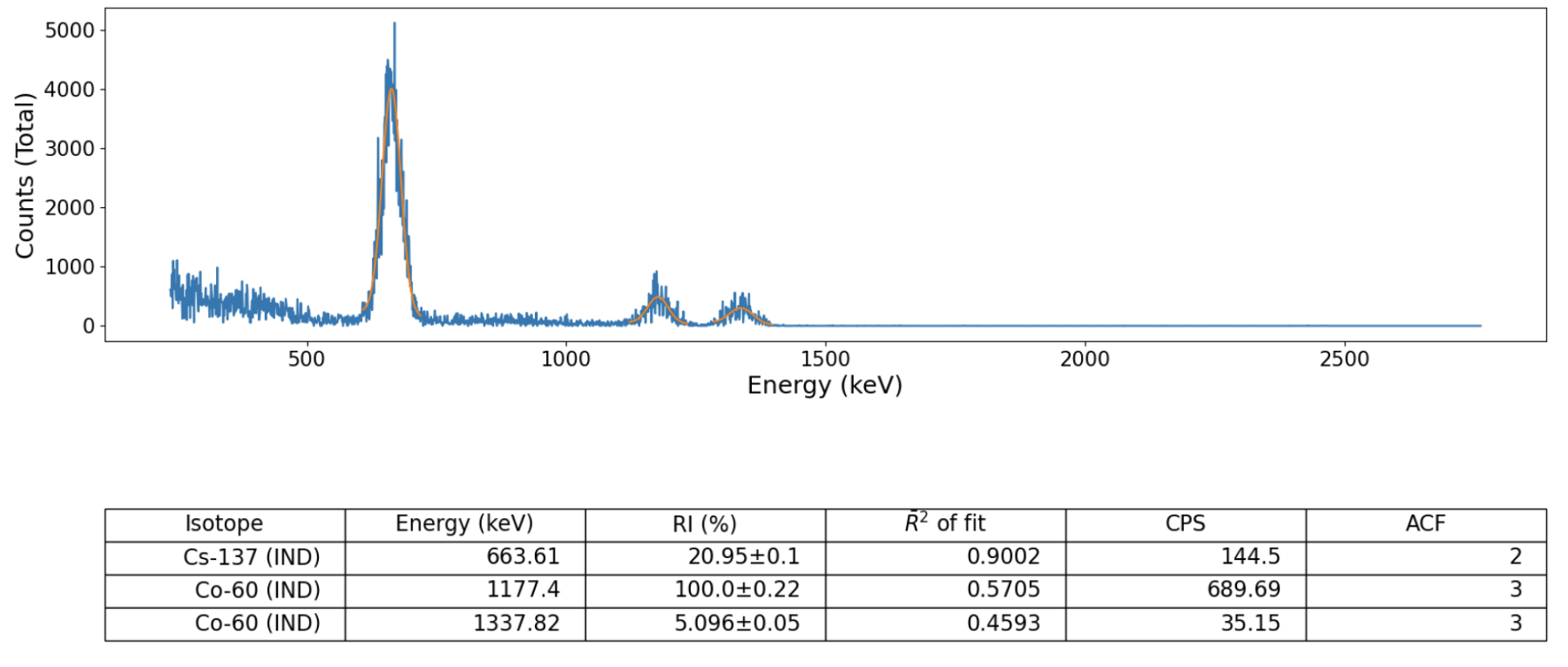
Each gamma emitting isotope emits particles of charecteristic energy levels. Isotopes can be identified by matching readings to reference spectrum/eV peaks. As a dosimeter, the detector adds the energy of each detection and measures detection rate (counts per second, CPS) to monitor total exposure.
There are a variety of scintillator crystal chemistries available specialized for different applications (energy ranges, spectral efficiencies, and effective resolutions).


Gamma spectroscopy is shockingly cheap and intuitive to explore as a hobbyist. Nowadays, you can get fairly precise gamma spectroscopy devices from manufacturers like Radview and Radiacode (~$200-$500). Other projects, like OpenGammaDetector, use low cost microcontrollers and open source hardware for even cheaper detectors. This post will outline such cheap detectors are possible and demonstrate the effective simulation and design of a gamma spectroscopy device.
The rest of this post is split into a few parts:
- a technical overview of particle detection circuits
- a guide to scintillator and SiPM selection
- modeling SiPM microcell avalanche + gamma scintillation events in LTSpice
- transimpedance amplifier, pulse discriminator, and peak detector design (with spice models)
- building a pocket sized DIY gamma detector
- reference material
Technical overview

The number of photons emitted by the scintillator is proportional to the energy level of the incident gamma particle. The SiPM contains an array of individually biased microcells, each of which can detect a single photon. Each triggered microcell avalanches in parallel, contributing to the total forward current (If). Peak If ranges from 25uA to a few mA, depending on the given SiPM and number of incident photons. The SiPM is reverse biased to something like 25-35V. The anode of the SiPM is connected to a low gain (e.g. 2, but it depends on the cell area) transimpedance amplifier to convert the SiPM output to a usable signal. This signal is routed to both a comparator which functions as a pulse discriminator and a peak detector which holds the peak signal level.
Scintillator crystal selection and silicone photomultiplier matching
LTSpice Model
Gamma Spectroscope PCB, V0.1
References
- Open Gamma Detector LINK
- ONSemi AND9782/D Biasing and Readout of ON Semiconductor SiPM Sensor LINK
- Improved SPICE electrical model of silicon photomultipliers LINK
- ONSemi AND9770/D Introduction to the Silicon Photomultiplier (SiPM) LINK
- An Open-Source Iterative Python Module for the Automated Identification of Photopeaks in Photon Spectra LINK
- LTC6244 High Speed Peak Detector LINK