Mind In Vitro
Open source cultured neuron headstage
The original Mind In Vitro publication provides a low cost, open source headstage system to interface cultured neurons with a computer. I have recently been working on replicating and revising the system with the help of some folks at Frontier Tower and Neuromorph VC.
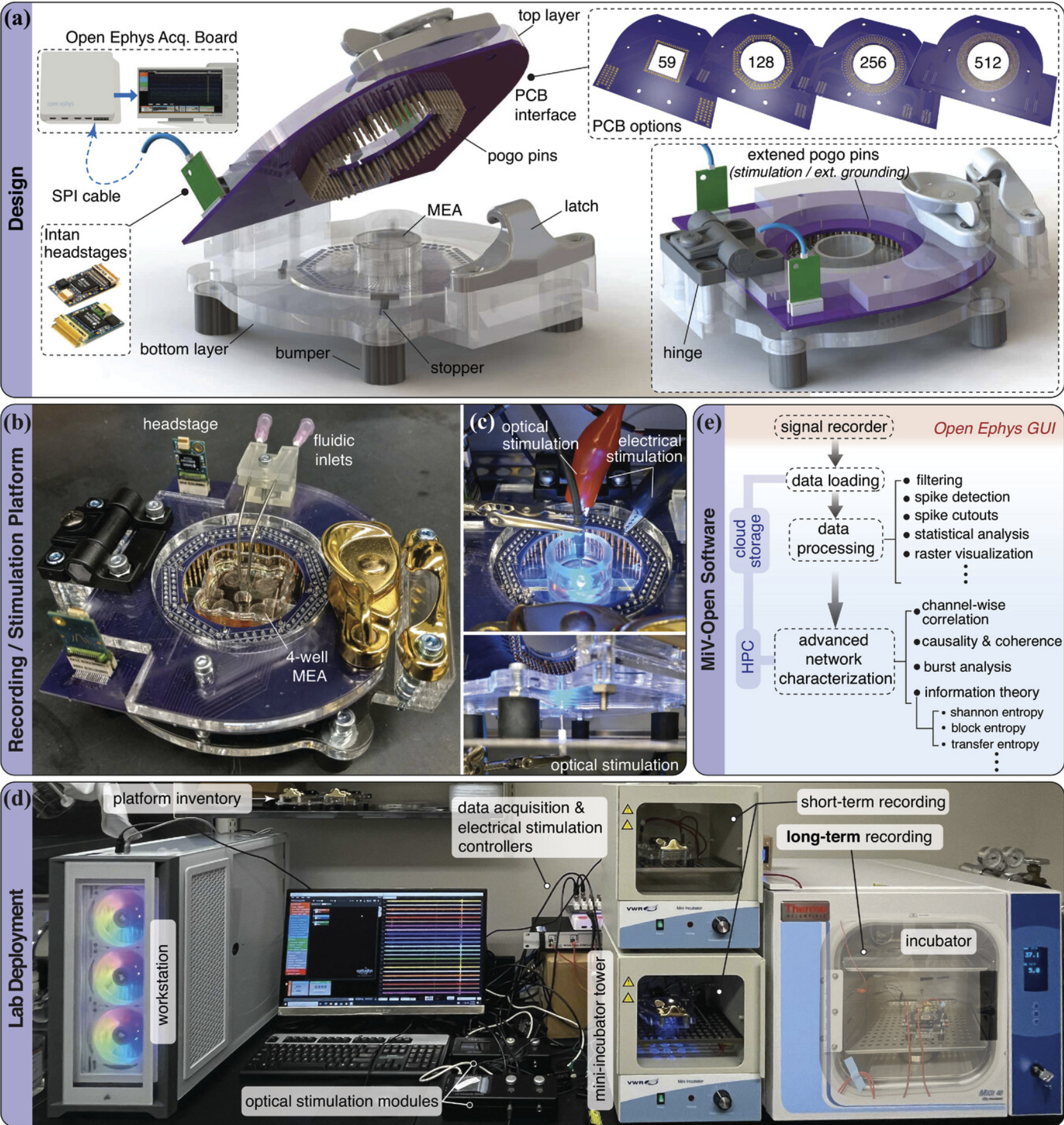
Many of the design files and protocols can be found in the project’s Github page
Tools/materials:
- Formlabs 3B/4B Resin printer for fluidic interface
- xTool CO2 Laser for acrylic parts
- Cloudray 60W MOPA 1064nm Fiber Laser
- Bambu Labs X1C FDM 3D Printer
- Basic electronics supplies
- Polyimide film (Kapton), no adhesive backing
- Currently testing HMDS and SU-8 for passivation
- Currently testing nano coating machine for passivation layer deposition
- LCR meter/impedance analyzer for electrode quality analysis
Electrode Interface PCBs
This board is responsible for connecting the MEA electrodes to our signal acquisition system. KiCAD design files are provided by the MIV team on GitHub. Boards are ordered from JLCPCB, PCBWAY, etc. A 3D printed jig is used to hold pogo pins in place for soldering.
Acquisition System
The acquisition system captures and records electrical activity sampled by the MEA array. The critical system parameters are:
- Channel count, determines the number of electrodes which can be recorded. Multiple acquisition boards can be connected to a single recording system, so the recording hardware sets the channel limit
- Sample rate, determines the frequency of neuronal activity which can can measure
- Bit resolution, determines the precision of the electrode voltage measurements
There are a few options for acquisition hardware:
- OpenEphys Acquisition Board (3rd Gen)
- Intan RHD Recording System
- Science Corporation SciFi Headstage
Acquisition boards (64-128ch each) containing analog front ends, simultaneous sampling ADCs, and (optionally) stimulation drivers plug directly into headstage interface PCBs and connect to the recording system via SPI.
MEAs
MEA fabrication is one of the major challenge for this project. This is something I’ve been working on for a while, but working with living neurons and higher array density is proving quite challenging.
There are a few components of MEA fabrication:
- Biocompatibility of underlying materials and electrode surfaces
- Patterning of pogo contacts and connecting traces (low density) + microelectrode array (high density)
- Passivation of connecting traces